
Traffic Court Records in Carbon County
Most traffic matters land in the Carbon County Justice Court. That single court serves Carbon County, Price, Helper, and Wellington, and its docket covers traffic citations, infractions, ordinance violations, and class B or C misdemeanors. You will find it at 751 E 100 N, Suite 1600, in Price, and the phone number is 435-636-3289.
East Carbon and Sunnyside citations deserve extra care. State listings tie Judge Jon Carpenter to the Carbon County, East Carbon, and Wellington Justice Courts, while county service text lists Carbon, Price, Helper, and Wellington. So trust the court and location printed on the citation first, then verify with the clerk. A DUI routed to District Court may need both a District and a Justice docket search.
Carbon Citation Search Fields
Utah Courts Xchange lets you run a traffic docket search by citation number or by party name. One catch: citation numbers are not unique statewide. That makes the Citation Location field essential. Pick Justice Court, or both jurisdictions if the venue or a DUI classification is uncertain, and set the Search Scope to Carbon County or the known court.
| Field | Use in a Carbon traffic search |
|---|---|
| Jurisdiction | Justice Court, or both when uncertain |
| Citation Number | Enter the ticket ID with Citation Location |
| Last/First Name | Use when the ticket is not at hand; wildcard can help |
| Case Type | TN, PN, PC, or possibly MD |
| Date panel | Limit filing or disposition dates when useful |
Each press of the search button costs money, and results cap at 500. Narrow the location and case type first.
How to Look Up a Traffic Ticket
Begin with the citation or notice itself. It should name your court and location. Utah's DTP instructions say to give a citation at least five days to reach the system. Then search Utah Courts Xchange. It charges $10 for one-time access, $0.20 per search, and $1 for an available public document. After identity verification, a party can also use the free MyCourtCase service.
- Read the issuing court, citation number, location, and response date.
- Wait at least five days if the citation is new and not yet found.
- Search Xchange with citation number plus location, or party name plus traffic case type.
- Open Case History and check proceedings, settings, and accounting.
- Verify the setting on the Carbon calendar or call the clerk.
- Use the clerk’s counter, public terminal, or written record request for missing material.
What if the ticket has not posted yet? The counter and the phone still work. For a mailed request, state the court, the case or citation number, the record you want, and whether you seek inspection or copies.
Five-Day Carbon Posting Gap
A brand-new ticket rarely shows up instantly. The official DTP page tells drivers to wait at least five days before checking eligibility. The case needs time to reach the system. Treat that as a practical benchmark only. It is never permission to ignore the date printed on the citation. If a deadline is close, call the Justice Court instead of waiting on an online result.
No result after five days: Check spelling, citation location, Carbon scope, and both jurisdictions. Then call 435-636-3289 and ask whether the citation has been entered and where it is filed.
Older or missing records have other routes. Some can be read at a courthouse terminal where offered, or requested through the Utah Request for a Record form. The county Clerk/Auditor's GRAMA process is separate from the state court docket channel.
Finding Your Traffic Court Date
Open Case History and read the newest proceedings or setting. That tells you where things stand. Next, check the Carbon County Attend Court page for the date, time, and location. The page also notes whether the hearing is in person or by Webex. The county says remote links appear within 24 hours. So join 15 minutes early, and expect several cases to share your listed time.
| Citation Number | A location-dependent identifier, shown here generically as citation + location. |
|---|---|
| Court | The Justice or District Court that owns the case. |
| Date and Time | The appearance or later setting; verify the newest event. |
| Location | In-person place or remote indicator confirmed by the calendar. |
| Status | Pending, disposed, paid, or another record-specific state. |
No Webex link after 24 hours? Call the Justice Court. A missing link earlier than that does not mean the hearing was canceled.
Carbon Webex Date Check
Carbon's calendar has a local wrinkle. Tuesday hearings run first-come, first-served, and several cases may share one remote-hearing time. The calendar entry supplies the video link for remote settings. Even so, compare the calendar against the newest court notice. Check the latest Case History event too.
A reset or continuance moves a setting. It does not dismiss the citation. An old setting can linger in the chronological history. The later notice or clerk confirmation controls. Call before traveling if the location is unclear. Ask for an interpreter about five days ahead when possible. Make ADA requests at least three working days before the hearing.
Paying or Contesting a Ticket
Paying resolves the citation under the applicable plea and fine process. Contesting means following the court's procedure for a plea and a hearing, not treating the payment screen as the only option. The response date on the citation plus current court instructions govern both paths. Court staff can explain the procedure, though they cannot give legal advice.
| Paying | Contesting |
|---|---|
| Use the correct case on the Carbon or Wellington payment route. | Contact the issuing court for plea and hearing procedure. |
| Online card payment adds a fee; American Express is not accepted. | A hearing or trial setting becomes part of Case History. |
| At the counter, use cash, check, money order, or cashier’s check. | Keep the citation and all later notices while the case is pending. |
Missed date or payment: Carbon’s published pages do not state a local failure-to-appear fee, warrant amount, or license procedure. Call 435-636-3289 at once to confirm case status and the current steps.
Carbon Deferred Traffic Prosecution
Carbon County Justice Court takes part in Utah Deferred Traffic Prosecution under Utah Code §77-2-4.2. Eligible drivers register through MyCourtCase within 21 days of the citation. They plead no contest. They pay the normal fine plus an administrative fee. Drivers then complete traffic school if required, and they keep a clean record for one year. Successful completion leads to dismissal, according to the Utah page.
DTP is voluntary. Eligibility depends on the case. It is not an instant deletion of the public record. The docket may still show the deferred process and the later disposition. Skip DTP and the normal payment or court route remains open. Carbon's page does not publish the exact total. So rely on the official eligibility and fine screen.
Court Traffic Record vs Driver Record
Two different offices hold these records. The clerk of the Justice or District Court keeps the case history that grows out of a citation, while the Utah Driver License Division keeps the statewide driving record. Searching a court docket shows the citation, the plea, hearing settings, the disposition, the fine, and payment entries. That docket search still does not replace a DLD record request.
| Court traffic record | Utah driver record | |
|---|---|---|
| Custodian | Issuing court and its clerk | Utah Driver License Division |
| Shows | Citation, plea, proceedings, result, fine | Convictions, points, and license actions reported there |
| Access | Xchange, clerk, terminal, record form | DLD record-request channel |
An Xchange result may be missing for reasons like posting, venue, privacy, or conversion. Either way, the gap says nothing about what sits in the separate driver record.
Carbon Traffic ODR Route
Carbon County Justice Court also offers a separate, free, voluntary pilot. It is called traffic Online Dispute Resolution. MyCourtCase checks whether a driver qualifies. To take part, you cannot have a lawyer, and the matter must be a qualifying minor infraction. You must sign up within 21 days. You cannot already be in DTP. Cases with serious injury, restitution, possible jail or probation, or a commercial driver are excluded. The prosecutor opens the chat within five days. You then have seven days to reply. The case goes back to court if either deadline fails. Seven days can pass without a message. Or no agreement is reached within 28 days. A judge has to approve the final deal. The deal can include a fine, a payment plan, community service, or a plea in abeyance. ODR still does not replace tracking the Case History and court notices. Utah's traffic case codes keep lookalike records apart in a broad docket search. TN means Traffic Citation, PN means Parking Citation, and PC means Parking Court Case. MD flags misdemeanor DUI. Check the code against jurisdiction and location rather than assuming one court holds every citation. Case History lists the charge, violation date, filing date, plea, and disposition. It also lists proceedings, accounting, and any public document link. The violation date and the filing date can differ. A balance is only an accounting entry. It is not proof that a hearing was canceled. It is also not proof that every obligation has ended. Before acting on an old printout, confirm the current status with Carbon County Justice Court. For a current fine or deadline, rely on the live court record and the clerk's answer. Published schedules never replace a case-specific order.
Fees and Copies
What a traffic docket costs depends on the product. Xchange bills for the search plus a linked image. The court record schedule sets the price of plain, certified, and exemplified copies. Paying a citation online adds a card fee. The Carbon page does not state the amount. That convenience fee is separate from any court-record copy charge.
| Item | Official amount or description |
|---|---|
| Xchange search | $0.20 per search within one-time access |
| Xchange document | $1 per available public document |
| Plain copy | $0.25 per sheet |
| Certified copy | $4 per document plus $0.50 per page |
| Exemplified copy | $6 per document plus $0.50 per page |
| Traffic ODR | Program is free; any case terms are specific |
The official Carbon payment page shows the correct online and counter methods.
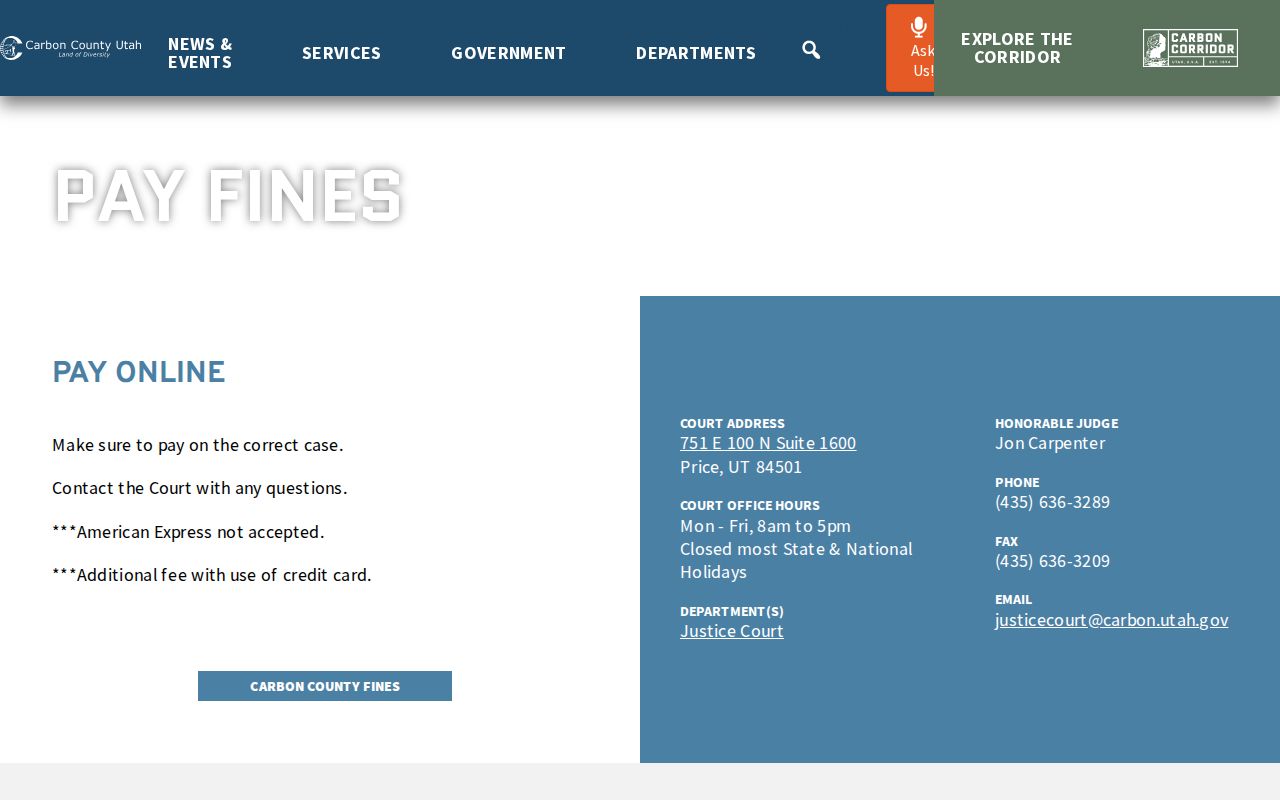
A payment screen only clears what you owe. It is not a substitute for the docket, the hearing calendar, or a copy the clerk issues.
Carbon Traffic Record Fallbacks
When Xchange or the calendar fails, call the Justice Court. You can also visit the counter in Price. Ask whether the citation has been entered. Ask which court owns it, and how to inspect or get the history. A free courthouse terminal may be available. A written Utah court-record request can seek inspection, paper or electronic copies. It can also seek review of a restricted record when the requester has a lawful basis. Mail the request to the court that holds the case. Include a specific description, your inspection or copy choice, contact information, the date, and a signature. Most replies come within ten business days. Staff may arrange payment for research or copies. Keep the products straight. The public case history, a purchased document image, a certified copy, and the driver record are all different things.