
How to Search Civil Dockets
Start your Carbon County docket search at Utah Courts Xchange. Pick District Court first, since most Carbon County civil cases live there. Add Justice Court if a small claim or other limited matter could be involved. You can search by case number if you know it. Or type a surname or company name into the Last name/Company field. The official wildcard helps catch spelling variants. Be sure to select Carbon County or a court location. Case numbers are not unique across the state.
Filters for case type and filing date will trim a long results list. Searching costs money, though. The one-time account fee is $10. Each search runs $0.20, and a document image adds $1. Results cap at 500, so narrow a common-name query before you pay for round after round of searching.
- Select District Court, Justice Court, or both.
- Set Carbon County or the correct court as Search Scope.
- Enter the number, party name, company name, or civil case type.
- Match court location, type, filing date, and party role.
- Open Case History/Documents and contact the clerk for an official copy.
Carbon Civil Court Split
Small claims aside, Utah District Court is where civil cases belong. In Carbon County, that job belongs to the Seventh District Court at Price, which holds the civil docket histories for contract, debt, tort, property, domestic, probate, judgment, and other general civil matters. Small claims stay with Carbon County Justice Court. Utah's filing table lists Price under Carbon County Justice Court and Sunnyside under the Carbon County East Precinct Justice Court route.
| Matter | Starting court | Search note |
|---|---|---|
| Contract, debt, tort, property | Seventh District Court | Use District and Carbon scope |
| Domestic or probate | Seventh District Court | Expect public/private limits |
| Small claim | Justice Court | Verify Price or East Precinct venue |
| Small-claims appeal | District Court | Trial de novo creates a District history |
A trial de novo means a brand-new trial in District Court, not a narrow review of what the Justice Court decided. So when an appeal is involved, run your case lookup at both levels.
What a Civil Docket Shows
A civil Case History opens with the basics: court, caption, case number, type, filing date, judge, parties, and attorneys. Party codes sort out who is who, marking plaintiff, defendant, petitioner, respondent, intervenor, garnishee, conservator, decedent, heir, and other roles. From there, the court docket can record the complaint or petition, service, answer, motion, notice, hearing, order, trial, judgment, abstract, garnishment, writ, satisfaction, transfer, or appeal.
| Case Number | Numeric Utah identifier; first two digits generally show filing year. |
|---|---|
| Parties | Caption and roles such as PLA, DEF, PET, or RES. |
| Proceedings | Dated filings, notices, settings, orders, and minute entries. |
| Judgment | The court’s formal decision and later satisfaction or enforcement entries. |
| Accounting | Revenue, trust, fees, sums paid, and balance when recorded. |
Think of the docket as a timeline, not a file cabinet. Some filed papers may not be viewable online. For a certified copy, only the clerk can provide that.
Carbon Civil Filing Mix
FY2023 numbers from the state paint a clear picture of Carbon's civil docket. The District Court logged 502 general civil filings, and 438 of those were debt collection. Eviction accounted for 55 of the 62 property-rights filings. Domestic cases came to 179, probate 85, and judgment matters 457. A docket search here tends to surface debt and judgment entries far more often than trials. That surprises some readers.
One caution: these are workload counts for that fiscal year in District Court. They do not measure open cases today. Adding them together to get a grand total would mislead.
Types of Civil Cases on the Docket
Civil dockets in Carbon County follow Utah's official case-type codes. CN means contract. DC marks debt collection. EV is eviction, and PR covers property rights. LM signals a lien or mortgage foreclosure. Torts have their own codes, covering automobile, intentional, medical malpractice, and premises liability claims. Domestic and probate filings sit under a separate code group.
- Contracts, fraud, debt collection, and judgment matters
- Eviction, property rights, foreclosure, condemnation, and wrongful lien
- Automobile, intentional, medical, and premises-liability torts
- Divorce, custody, support, protective-order, and paternity matters
- Estate, conservatorship, guardianship, and name-change cases
Small claims carry the SC prefix in a Carbon County court docket. The dollar limit shifts over time, so check Utah's live small-claims page before you file anything.
Carbon Civil Judgment Codes
A judgment code records a result on the civil docket. But it does not tell the whole story. Utah recognizes several variants, including agreed, default, summary, stipulated, bench, and jury judgments. Among these, SA marks a satisfied judgment. A RO code means the case was reopened. Dismissal codes carry their own distinctions. These include with prejudice, without prejudice, voluntary dismissal, or dismissal for lack of prosecution.
- Default judgment
- A judgment entered after a required response or participation did not occur.
- Summary judgment
- A ruling without trial on issues the court can decide from the record under governing procedure.
- Stipulated judgment
- A judgment based on terms agreed by the parties and accepted by the court.
- Satisfaction
- An entry showing the judgment obligation has been satisfied as recorded.
Read the dated order plus everything filed after it. One judgment can trigger an abstract, garnishment, writ, satisfaction, appeal, or reopening.
Settings and Hearings on Civil Dockets
Civil settings come from several sources. A motion, a scheduling order, a status event, an evidentiary hearing, or a trial notice can all set one. Sometimes the Case History still shows an old date. A later order may have moved the hearing after that. So work through the entries in order. The newest future setting is the one that counts. A later notice, order, or direct word from the clerk beats any older entry. If a setting looks unclear, call Carbon District Court at 435-264-4640. Treat the docket as a history, not a live promise that a hearing still stands. The Carbon County court calendar walks through the full date-check process.
Carbon Civil Service Is Separate
The Sheriff's civil-processing office handles the physical work of a lawsuit. It serves summonses, subpoenas, garnishments, judgments, executions, and writs across Carbon County. It is separate from the clerk's docket search desk. Fees are posted by the county. Ordinary civil papers run $20 plus $2.50 per mile. Executions, civil bench warrants, and writs of possession run $50 plus $2.50 per mile.
That split matters once a judgment is entered. Pulling a certified copy from District Court gets you the document, nothing more. It does not serve the other side or enforce anything. Later service and enforcement steps may add their own docket entries. But the Sheriff's fee buys civil process, not access to Case History. For questions about the court record itself, call the clerk.
Public Access to Civil Dockets
You have a few ways to pull a Carbon County civil docket history. Xchange offers a free terminal at the courthouse where available. The clerk's counter handles requests in person. The Price District Court takes calls at 435-264-4640. Justice Court sits at 751 E 100 N, Suite 1600, Price. Its phone is 435-636-3289. Mail or written requests go through the Utah Request for a Record form. The court typically answers within ten business days.
Public does not mean every paper: UCJA Rule 4-202.02 presumes access unless a record is classified otherwise. Rule 4-202.03 limits non-public records to authorized people or court order.
Privacy gets layered in domestic cases. Orders, decrees, letters, and hearing entries may stay public while the pleadings stay sealed from view. Sealed matters, protected data, and personal identifiers face still tighter limits. For county administrative records, Carbon County GRAMA is the right office. But it does not hold state judicial case files. Older civil dockets can take a different path. Many records more than 50 years old now live at the Utah State Archives, according to Utah Courts. Newer material usually stays with the court that created it. Justice Court conversion history can also leave an online case with fewer entries than its paper file. So if Xchange comes up empty, ask the District or Justice Court clerk first. Then follow whatever archive route that clerk points out. Party status opens more doors. MyCourtCase gives a party free access to case history, filed papers, hearings, payments, and linked cases. Identity must be verified first. It is not a way to search someone else's name. Registered lawyers and government filers use Utah eFiling, a separate channel. Items filed there enter CORIS after processing, and Xchange serves as the public summary layer. Neither tool changes how a private domestic pleading or sealed record is classified. A judgment request works best when you name the exact event and date, if known. The written form asks which judiciary office should receive it. It asks what record you want. It also asks whether you seek inspection or copies, and how the court should reply. Inspection costs nothing. Copy, research, electronic delivery, certification, and staff-time fees may still apply under Rule 4-202.08. Anyone asking for non-public material must state and document the legal basis for access. The clerk may call to clarify scope or arrange payment. A narrow request helps. Tie it to the correct case number. That usually spares you needless staff research.
Certified Carbon Civil Judgments
A screen print from Xchange is not a certified judgment. Start by pinning down the case and court. Then ask the record-holding clerk for the exact judgment or order you need. Utah's current fee schedule sets the rates. Plain copies cost $0.25 per sheet. Certified copies run $4 per document plus $0.50 per page, and exemplified copies run $6 per document plus $0.50 per page. Email or fax delivery runs $5 for up to ten pages, then $0.50 per page. The official request page walks through inspection, copies, staff-time payment, and restricted-record review.
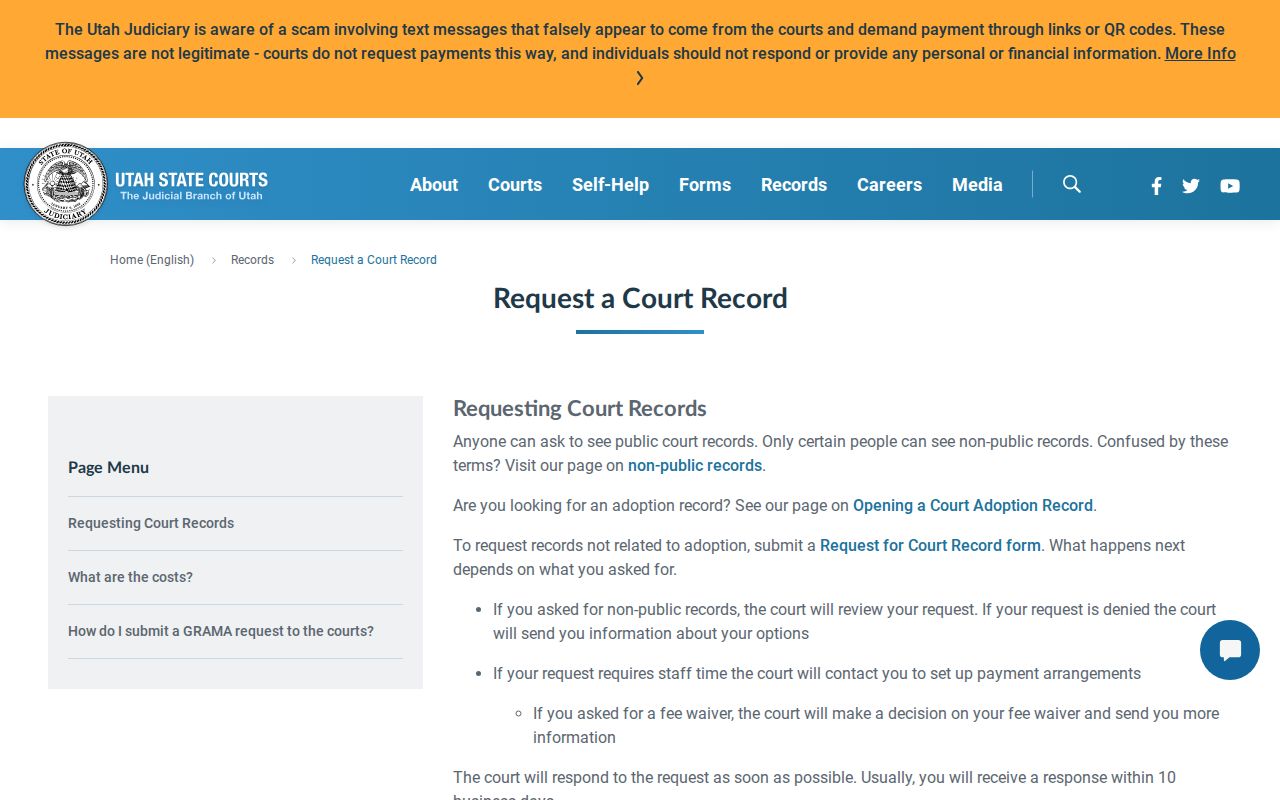
The request route gets you a clerk-supplied record. For simply locating the right case and event first, Xchange stays the faster tool.