
How to Get Court Records
Know which office holds the file you want. In Carbon County, that depends on the case type. The Price District Court clerk keeps felony, class A misdemeanor, civil, domestic, probate, and property case files. Small matters sit elsewhere. Carbon County Justice Court holds lower-level misdemeanor, infraction, traffic, ordinance, and small-claims records within its jurisdiction. Juvenile Court keeps its own restricted files, and the elected Carbon County Clerk/Auditor handles county administrative GRAMA records. That office does not replace the state court clerk.
- Identify the court and case with Utah Courts Xchange, a notice, or the clerk.
- Decide whether you need case history, inspection, a plain paper or electronic copy, a certified copy, an audio record, or a transcript.
- Use Xchange for public summaries and available $1 documents, or MyCourtCase for free eligible party access.
- Visit the holding clerk or a courthouse public terminal when remote access is incomplete. Verify terminal availability first.
- Call Price District Court at 435-264-4640 or Justice Court at 435-636-3289 for routing.
- Submit the Utah Request for a Record form in person, by mail, or through the court’s accepted email route when a written request is needed.
- Describe the case number, party, event date, and exact document; then arrange any copy, certification, media, mailing, or staff-time fee.
For Carbon record and audio requests, Seventh District materials list pricedistrictdocs@utcourts.gov, and Justice Court lists justicecourt@carbon.utah.gov. Confirm the current route with the court before you send private identifying material.
Carbon Docket, PDF, or Certification
Three products get mixed up constantly. A docket, labeled Case History or Extended Case History in Xchange, is the chronological public index of parties and proceedings. It covers hearings, judgments, and outcomes. It is not the paperwork itself. A filed document is the actual complaint, motion, order, judgment, citation, exhibit, or other paper in the case file. When an electronic image exists, Xchange may offer a public PDF for $1. A certified copy is different again: the clerk issues it with formal certification.
| Product | Best source | Use |
|---|---|---|
| Case History | Xchange or courthouse terminal | Track public events and locate a case. |
| Filed document | Xchange link or holding clerk | Read the actual public filing or order. |
| Certified copy | Holding court clerk | Provide official proof when certification is required. |
A downloaded screen is not certified, and it may omit a private filing hidden behind a public history. Ask the recipient which form is required before you pay for the wrong product.
Types of Court Records
What a court record looks like depends on which court holds the case and how that case is classified. Carbon County files can hold several kinds of material, and each item stands on its own. Getting one piece does not unlock the rest of the docket file.
- Case History and Extended Case History entries
- Complaints, petitions, motions, answers, and other public pleadings
- Orders, judgments, decrees, and letters that remain public
- Criminal charges, pleas, dispositions, and sentence entries
- Civil, domestic, probate, small-claims, and traffic files within each court’s jurisdiction
- Electronic hearing audio and separately prepared transcripts
- Older court material transferred to Utah State Archives
Not every file in a Carbon County court docket is open to everyone. Adoptions, juvenile files, mental-health commitments, sealed cases, expunged matters, protected victim data, and private domestic pleadings all sit behind tighter rules. Even within one case, a public order can sit alongside pleadings that stay private.
Carbon Judicial Request Form
A document may not be available through Xchange or at the counter. Then the Utah court-record request process kicks in with a written form. On the “To” line, write Price District Court or Carbon County Justice Court. The form asks you to describe the records with reasonable detail. Then pick inspection or copies. Inspection itself costs nothing. The official page lays out each step of the request.
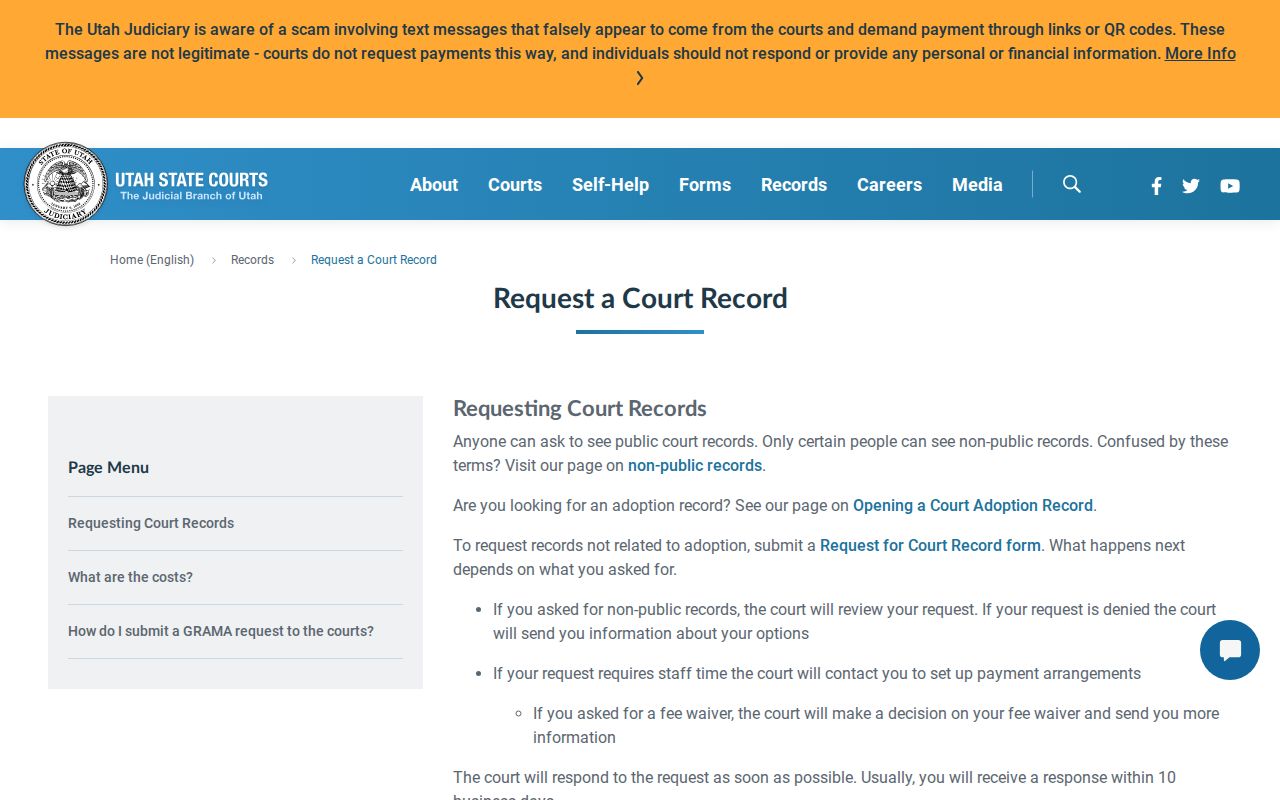
The form ties everything together: identification, delivery, your basis for access, and fee arrangements. Want a non-public record? You must state why you qualify. That could be as the subject, the information provider, or another authorized person, and attach proof. The expedited option needs media, public-benefit, or similar support under Rule 4-202.06. Sign it, add a name, mailing address, daytime number, and date. Expect a decision within ten business days. If paid research is needed, staff will reach out.
What a Court Record Contains
What shows up in a Carbon County court record varies with the case type and with which papers are open to the public. The field map that follows draws on Xchange's own official samples.
| Case header | Court, location, caption, number, type, filing date, and assigned judge. |
|---|---|
| Parties | Plaintiff, defendant, petitioner, respondent, other roles, and attorneys. |
| Proceedings | Chronological court events and minute-entry information. |
| Criminal detail | Charges, severity, agency, citation, violation date, plea, and disposition when public. |
| Civil detail | Case type, pleadings, proceedings, and some post-judgment due dates. |
| Orders and judgments | Rulings and outcomes that are public. |
| Documents | Public electronic images when a purchase link is available. |
| Accounting | Revenue, trust, fines, fees, amounts paid, and balance when applicable. |
Do not read the public index as a guarantee that you will see exhibits, protected identifiers, sealed papers, or every older document. Some items stay closed. The clerk can tell you whether a public item exists and walk you through how to request it.
Carbon Audio Is a Separate Record
The clerk of Carbon District Court keeps the case file and docket. A hearing audio file captures the proceeding as sound. A transcript is different. It is a word-for-word written product made by a court reporter or certified transcriber. One cannot substitute for the other. To request Carbon District audio, write to pricedistrictdocs@utcourts.gov and follow the Utah Courts instructions. Attorneys file these requests through e-filing, while everyone else emails the right location. The court works out the cost and wants payment before it releases anything.
The rates follow a set pattern. An electronic audio or video proceeding record runs $15 per half-day of testimony. An FTR Cloud shared recording is $10. Want a USB or disc instead? That is $15, plus actual postage if it goes by mail. A first certified transcript costs $6 per page. Later certified and non-certified copies carry different rates. Tell the court which proceeding date and session you need. That way it can pull the correct recording.
Certified Copies and Fees
A plain copy just reproduces the public record. Certified copies add the clerk's certification, and exemplified copies add formal authentication on top of that. Utah's court fee and records rules set these fees, so downloading a document is never treated as certification.
| Item | Amount or rule |
|---|---|
| Paper copy | $0.25 per sheet |
| Email or fax copy | $5 through 10 pages, then $0.50 per page |
| Xchange document | $1 per document when available |
| Certified copy | $4 per document plus $0.50 per page |
| Exemplified copy | $6 per document plus $0.50 per page |
| Abstract or transcript of judgment/order | $50 |
| Staff time | First 15 minutes free; later time uses the applicable staff rate |
| Mailing | Actual court mailing cost |
Carbon County court staff will not fax or email a record you can already pull from Xchange, so plan on that platform for those copies. A fee waiver is still possible, though. Mark the qualifying basis on the form and attach the required proof when you file the request.
Carbon County Justice Court Clerk
751 E 100 N, Suite 1600
Price, UT 84501
435-636-3289
Carbon Archives and Older Files
Older Carbon County court files often live at the Utah State Archives. That repository holds court records more than 50 years old. Anything newer usually sits with the court that made it. Justice Court conversion dates vary by location. So an old case might return no online result. It might show only a thin Case History, even though the paper file still exists somewhere. Before sending a wide request, ask the court where the file actually lives.
Old case codes can look strange next to today's menus. Utah's code list flags some types as no longer used after a stated year. When you request an old Carbon County record, keep the code and the filing date handy. That lets Archives and the current clerk figure out which office holds the file. A failed Xchange search never proves the record never existed.
Carbon GRAMA or Court Request
Carbon County GRAMA requests and Utah judicial record rules lead to different offices. County-government records go through the elected Clerk/Auditor at 751 E 100 N, Suite 1100. You can submit online, in person, or by mail. District and Justice Court files are different. Those requests must go to the court holding the case. The Utah Code of Judicial Administration governs them.
Use the right custodian: send a court complaint, order, case history, or certified judgment to the court clerk, not the county Clerk/Auditor’s general GRAMA process.
County Attorney records raise one more wrinkle. Asking the attorney's office for material or discovery is not the same as asking for the judicial docket. Name the actual document and its creator before you file anything. Getting this right up front avoids delay. It also keeps the ten-business-day judicial response clock from starting at the wrong office.
Public Access and Sealed Records
UCJA Rule 4-202.02 sets the default: a Carbon County court record is open to the public unless the law labels it private, protected, safeguarded, sealed, or otherwise off limits. Rule 4-202.03 then draws the line in practice, letting anyone view a public court record while limiting other files to people with authority or a court order. Fees for copies, service, staff time, and waivers fall under Rule 4-202.08.
Key access limits: juvenile records fall under Utah Code §78A-6-209, while Utah Code §§77-40a-401 and 77-40a-404 restrict ordinary access to processed expunged records.
Some cases stay out of plain sight in Xchange. Juvenile matters, adoptions, civil commitments, private domestic cases, and records shielding a victim can all be closed to the public. A case file can hold both open pages and sealed ones at the same time. So a public history does not mean every paper is public.
Getting at restricted material takes a lawful basis. You must state that basis on the request form. For a sealed record, the court itself generally must grant permission first. The clerk decides what form of the record can be released, so ask that office rather than trusting what an online listing shows.
Carbon Record Request Precision
A precise request saves the clerk research time. It also cuts the odds of getting the wrong item. Include the Carbon County court location, the full case number, party names, the document title, and the filing or hearing date when you know it. Say whether you want inspection, a plain copy, certification, exemplification, audio, or a transcript. Each choice carries its own process and fees.
For a broad file, ask first whether Case History can pin down the exact entries. The first 15 minutes of staff research are free. But added work can be billed at the applicable rate. Never put money in the Seventh District secure drop box. Once staff confirms the record can be released, follow the current clerk's payment and delivery instructions.