
How to Search Criminal Dockets
Utah Courts Xchange is the main public search for criminal case information. It covers Carbon County District Court and Justice Court. Pick District Court, Justice Court, or both. Then narrow Search Scope to Carbon County or the specific court you know. A case number works best. Utah warns, though, that numbers are not unique statewide. Pair it with the defendant name, birth date when available, case type, citation number, or citation location. The first two digits of a case number usually mark its filing year. Hit search only when the fields look right. Each search button click creates a billable event. One-time access costs $10, each search costs $0.20, and a linked public document costs $1. Parties with a verified case can try the free MyCourtCase portal instead. It is not a public name search.
- Select District Court, Justice Court, or both.
- Limit the scope to Carbon County or the known court location.
- Enter the number, or search the defendant’s name with the official wildcard option.
- Confirm location, case type, filing date, and party code.
- Open Case History/Documents, then ask the clerk for certification if needed.
Carbon Criminal Court Boundary
Court level makes a strong search filter. The Seventh Judicial District at Price holds every Carbon County felony docket. It also holds class A misdemeanor dockets. Class B and C misdemeanors, infractions, traffic charges, and ordinance cases stay with Carbon County Justice Court. That court serves Carbon County plus the Price, Helper, and Wellington area. For an East Carbon or Sunnyside venue, check the citation or court notice before you search.
| Case level | Carbon court | Xchange choice |
|---|---|---|
| Felony or class A misdemeanor | Seventh District Court | District Court, Carbon scope |
| Class B/C misdemeanor or infraction | Carbon County Justice Court | Justice Court, Carbon location |
| Juvenile delinquency | Seventh District Juvenile Court | Not in ordinary public Xchange |
When the offense level or transfer path is unclear, search both court tiers. The court location shown on the entry controls.
What a Criminal Docket Shows
A criminal docket entry in Xchange names the court, caption, numeric case number, case type, filing date, and current judge. Parties and attorneys appear as well. The criminal block can add the law-enforcement agency, officer, prosecutor, citation number, violation date, charge, and severity. Special attributes may appear too. Proceedings line up filed papers, court events, pleas, rulings, sentence, and disposition in date order. Accounting may list fines, fees, trust or revenue entries, payments, and a balance.
| Case Number | A numeric, year-prefixed ID such as 24•••••••; match it with location. |
|---|---|
| Charge | Offense description, severity, and displayed special attributes. |
| Proceedings | Chronological Case History entries, including hearings and minutes. |
| Plea | Date and recorded response, such as guilty, not guilty, or no contest. |
| Disposition | The outcome, which can differ by charge within one case. |
A Carbon County criminal docket gives you the public history of a case, not the whole certified file. For official copies, the court clerk is the office to ask.
Carbon Criminal Dates Differ
Dates on a Carbon County docket can look contradictory without being wrong. The violation date marks the alleged act itself. The filing date marks when the court opened or entered the case. Utah's Xchange help notes that the two often differ. Before ruling out a match, compare the charge, defendant, court, agency, and citation fields. A plea and a disposition also play different roles. The plea is the defendant's response. The disposition records what the court did with each charge. Later events might include sentencing, transfer, reopening, remand, or a treatment order. Read the full sequence. The newest short code may not explain the route that produced it.
Stages on a Criminal Docket
A Carbon County District Court case may open with a charging paper. An early appearance often follows. Arraignment, motions, pretrial settings, plea or trial, disposition, and sentence tend to follow. Justice Court runs its own lower-level path. Some matters get bound over or transferred. A District Court case may follow a Justice Court entry, and one history may not show every stage.
Docket flow: Charge Filed › Initial Appearance or Arraignment › Pretrial Proceedings › Plea or Trial › Disposition › Sentencing
The Seventh District page requires a Statement of Defendant in Support of Plea(s) and Certificate of Counsel for all class A misdemeanor and felony pleas. That form may sit behind an event. Its image need not be public online.
Carbon Criminal Codes in Context
Utah publishes its codes, so no one has to guess. FS means state felony, and MD means misdemeanor DUI. Among disposition codes, BF is bail forfeiture, PA is plea in abeyance, and DV is diversion. TR is transferred. Read each code beside the dated event and charge it affects.
- G, GP, GB, GJ
- Guilty variants, including plea, bench, and jury outcomes.
- NC, NB, NJ
- No contest or not-guilty bench and jury results.
- D, DI, DL
- Dismissal variants, including with prejudice or lack of prosecution.
- XA, XN, XP
- Automatic expungement, exoneration, or expungement.
Plea in abeyance: the case did not vanish. Later compliance and court action decide how it ends up in the record.
Which Court Holds Criminal Dockets
The Carbon County District Court Clerk at Price keeps felony and class A misdemeanor histories. That office sits at 149 E 100 S, Price, and its phone is 435-264-4640. Lower-level criminal histories stay elsewhere. The Carbon County Justice Court Clerk holds them, at 751 E 100 N, Suite 1600, Price. That office answers at 435-636-3289.
Most district courthouses offer a free public Xchange terminal. Some justice courts do too, so call first to confirm local access. You can also inspect court records at the clerk's counter. Or mail and deliver a Utah Request for a Record, or phone the office about the proper request method. Judicial records belong with the court clerk, not Carbon County's elected Clerk/Auditor.
Missing Carbon Criminal Case
A no-match search is not the end of the road. A Carbon County case can still exist. Even when nothing comes back. Trim the extra name details and try a first-name wildcard. Run the docket search in both jurisdictions, and confirm you actually scoped it to Carbon. Older Justice Court records carry less detail. Entries reached CORIS at different times. A brand-new filing may simply be waiting on staff entry.
Still nothing? Call the clerk or use a courthouse terminal. The Utah court-record request process takes a written description. It also asks your choice of inspection or copies, an access basis when needed, contact details, date, and signature. Most replies land within ten business days. County Attorney discovery is a separate product, not the public judicial docket.
Restricted cases: A sealed, expunged, juvenile, or private case may return no public placeholder. Access requires legal authority or a court order.
Carbon's FY2023 District Court caseload puts the criminal docket in scale. The official table shows 697 criminal filings for the year. That figure includes 376 state felony filings. It also counts 191 other misdemeanor filings and 17 misdemeanor DUI filings. Count filings, not outcomes; these numbers say nothing about pending cases or results. They also describe District Court alone. So do not read them as Carbon County Justice Court's total traffic or misdemeanor volume.
Problem-solving courts stay tethered to the underlying judicial record. Utah's directory lists Adult Drug Court at Price. It also lists Adult Mental Health Court in Carbon County. A public Case History may display a treatment order or program event. Medical disclosures, screening material, and treatment details stay private. That holds even when the base case has public entries. The clerk can say which filed items you can see without revealing restricted program information.
Justice Court numbers sit in a separate series. The FY2023 statewide report lists Carbon Justice Court rows. It shows 632 other misdemeanor filings, 85 misdemeanor DUI filings, and 38 infractions. Carbon posts no traffic-only count, so no traffic total should be inferred from those rows. Always keep the court-level label and source year attached to the numbers.
Public Access and Sealed Criminal Dockets
Utah rules presume court records are public. They stay open unless they fall into a private, protected, safeguarded, sealed, or otherwise non-public class. A public Carbon County history shows charges and hearings. It can also display pleas, rulings, outcomes, accounting, and available images. Personal identifiers and protected victim details may be masked. Juvenile delinquency matters belong to Juvenile Court and ordinarily stay out of Xchange.
Key rules:
UCJA Rule 4-202.02 classifies public and non-public judicial records.
UCJA Rule 4-202.03 permits public access and limits restricted records.
Utah Code §77-40a-401 restricts ordinary access after an expungement order is processed.
Public access lets people track their own matter, confirm a hearing, or follow a case of public interest. It never overrides a sealing order.
Carbon Criminal Access Channels
Xchange supplies public summaries and some images. MyCourtCase is free for a verified party. That person can see the history, filed papers, payments, and remote-hearing links. Registered lawyers and government filers use Utah eFiling, which is not a public viewer. Court staff process filings into CORIS, and CORIS feeds Xchange.
Need a document that is not online? Try the counter, the phone, or a public terminal. The record form, mail, and the district records email at pricedistrictdocs@utcourts.gov also work. Carbon District and juvenile audio requests go there too. Audio can cost $15 for a half day or $10 through FTR Cloud. Remember that a history, an audio recording, and a certified judgment are three distinct records.
The official Price courthouse directory confirms the local court contact.
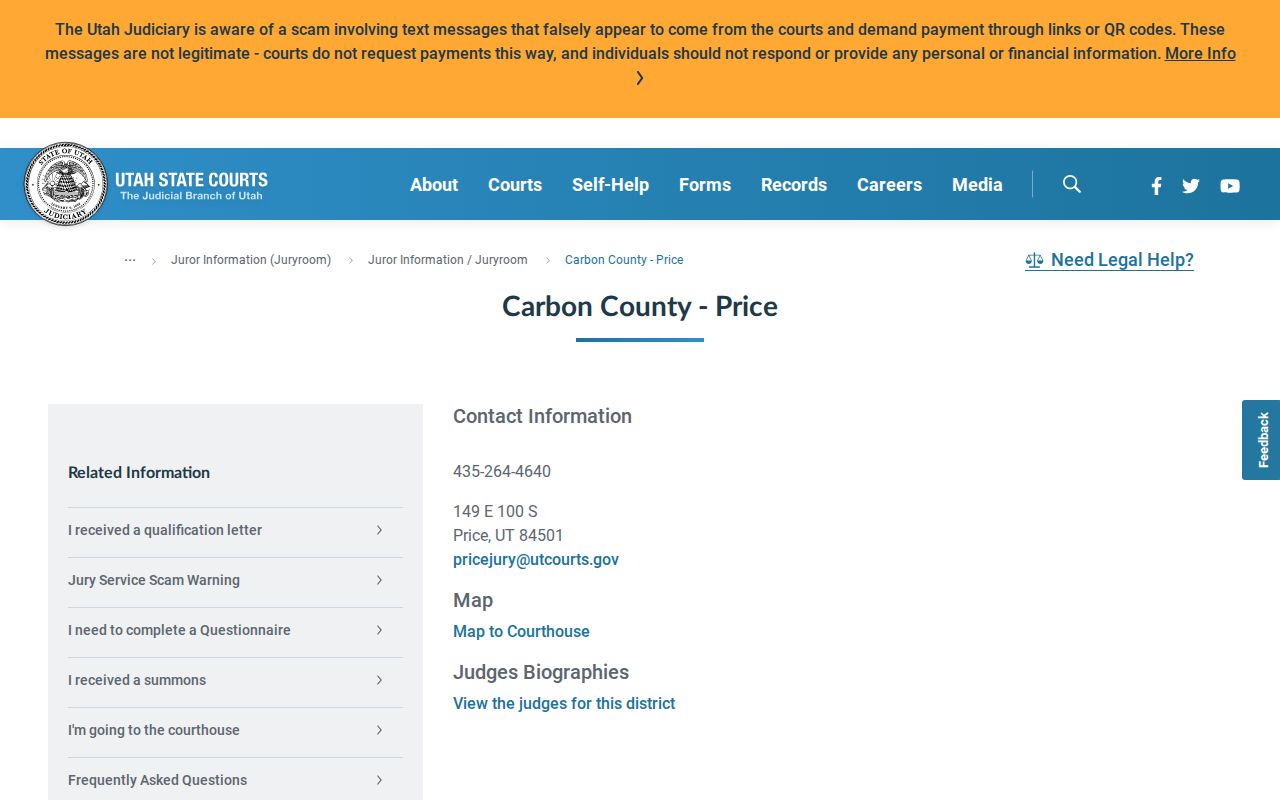
The directory points you to the access channel. The case data itself still comes from Xchange or from the clerk holding the original record.