
Searching Cases by Name
The statewide public search for case information in CORIS is Utah Courts Xchange. Names must match exactly unless you add a wildcard. Spelling and court scope carry real weight. A common surname can also slam into the 500-result ceiling before you see the case you want. To keep a Carbon County docket search manageable, narrow the location. Pick District Court, Justice Court, or both, then add a case type or date range if the list runs long.
- Choose the jurisdiction that fits the case, or select both if uncertain.
- Set the search scope to Carbon County or the known Price court location.
- Put a surname or company name in Last name/Company.
- Add the first name only when it will not hide middle-name variants.
- Use an asterisk wildcard for uncertain spelling or middle initials.
- Add a case type or filing-date range to reduce a broad result set.
- Confirm County, Court Location, Case Type, and Filing Date before opening the case.
Searching a company? Official help says to put the business name in the last-name field and use a wildcard. Keep one caution in mind. A no-match result does not prove that no Carbon County case exists, so try less name detail, both jurisdictions, and the clerk as a fallback.
| Search field | Carbon County use |
|---|---|
| Jurisdiction | District Court, Justice Court, or both. |
| Last name/Company | Surname or business name, with wildcard if needed. |
| First Name | Given name; an asterisk can catch middle-name variants. |
| Case Type | Utah code for the subject of the case. |
| Search Scope | Statewide, county, or particular court. |
| Date panel | Filing, disposition, judgment, or judgment-disposition range. |
Carbon Jurisdiction Comes First
Many a Carbon County docket search fails for one dull reason: it started in the wrong court. The Seventh District Court at Price holds felony and class A misdemeanor cases. It also covers broad civil, domestic, probate, and property matters. The Carbon County Justice Court takes class B and C misdemeanors, infractions, traffic and ordinance cases, and small claims within its jurisdiction. Juvenile justice and child-welfare files sit with Juvenile Court. They generally stay out of ordinary Xchange public results.
City routing matters here too. Price, Helper, and Wellington matters can move through the county Justice Court arrangement. East Carbon and Sunnyside can follow an East Precinct route, including the small-claims location Utah Courts lists. So the city printed on a ticket is a location clue, not proof of a separate search system. When venue stays unclear, search both public jurisdictions and compare the Court Location field on each result.
Searching by Case Number
The case number is usually the strongest key to any docket lookup. Utah help says its first two digits mark the filing year. Yet the number itself is not unique statewide. Pair it with Carbon County or a court location every time. A recent number may look like 24#######, a numeric form with the year in front. But the digits that follow are not a fixed Carbon prefix.
Type in what you know and choose District or Justice Court. Narrow the scope from there. Then compare the returned court, case type, and filing date against the notice in your hand. Citation numbers are not unique statewide either. Pair each citation with its location. Never force punctuation or invent digits that are missing. If a copied number fails, fall back to a name and year search. Then ask the clerk to verify the number.
Carbon Xchange Search Costs
Xchange can look free at the entry screen. It is not. Remote public searches are billable through the ordinary account path. The one-time option costs $10. Each search runs $0.20, and public document links cost $1 per document. A monthly account carries a $25 setup charge plus $40 per month. It includes 500 searches and then charges $0.35 per added search. Remember that the Search button counts against your total even when the results are poor, so a sloppy docket search costs real money.
Narrow before clicking Search: add Carbon County, the jurisdiction, and a reliable name, number, case type, or date to avoid needless broad searches.
The official Xchange search-field examples are captured below.
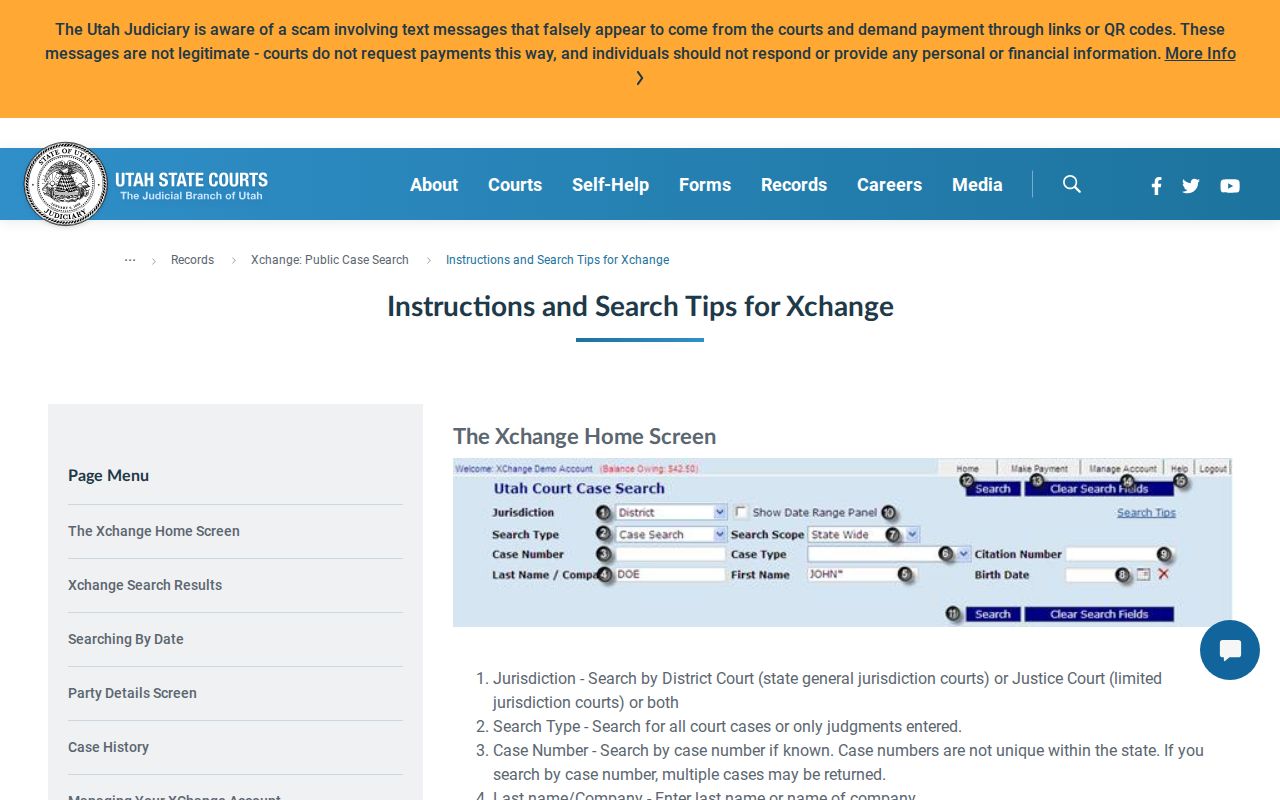
The official page makes the design plain: this public tool is a structured statewide search with filters, not a single Carbon County name box. Treat it accordingly and narrow by county and court.
What a Case Search Returns
A results list starts small on purpose. It shows just enough detail to tell records apart. Open the case number for the expanded history, click a party name for party detail, and use Case History/Documents to reach the case summary plus any purchasable public images.
| Case Number | A numeric year-prefixed identifier that must be paired with location. |
|---|---|
| County and Court | Carbon County and the District or Justice Court location holding the case. |
| Case Type | The Utah subject code, such as FS, DC, EV, DA, ES, SC, or TN. |
| Caption and Parties | The case style, party names, roles, and attorneys when public. |
| Filing Date | The date the case was filed, which can differ from a violation date. |
| Judge | The current assigned judge in the case header. |
| Proceedings | Chronological events and minute entries in Case History. |
| Outcome and Accounting | Public dispositions, judgments, fines, fees, payments, and balances when applicable. |
| Documents | A purchase link when a public electronic image is available. |
A visible case does not make every filing public. Some documents stay private or protected even behind a fully public case history in the Carbon County court docket.
Carbon Case History or Documents
Case History is the docket-like timeline of a case. It lists public proceedings, minute entries, hearings, judgments, and outcomes. A filed document is the paper itself, whether that is a complaint, petition, motion, order, or citation. Xchange may sell a public PDF for $1, though coverage is not complete. Public district documents filed electronically since July 1, 2010 may be available. Justice-court conversion work and older records vary.
One caution matters. A screen print is not a certified record. If an agency or another court needs official proof, request a certified copy from the Carbon County clerk. The clerk can also chase down a missing image, handle a correction, or pull a paper file. That distinction keeps a search result from being mistaken for the full Carbon County court record.
Statewide vs County Case Search
Carbon County has no county-only public docket database as its primary route. Instead, Xchange delivers statewide reach and local narrowing in one official system. The county layer works as a filter, not a second competing portal.
| Statewide Xchange scope | Carbon County scope |
|---|---|
| Useful when the filing county is unknown. | Best when the case is known to be local. |
| Can return same-number cases from several locations. | Reduces number and common-name ambiguity. |
| Search District and Justice Court records across Utah. | Focus on Price District and Carbon Justice locations. |
| Broad results may reach the 500-record cap. | Court and type filters make review more precise. |
MyCourtCase is a different animal. It gives free party access to a user's own eligible case history, papers, payments, hearings, and linked cases. Utah eFiling differs too. It serves registered filers and feeds CORIS after court processing, so it is not a public case browser.
Carbon Codes Narrow Results
Case-type codes work like a precision filter on a Carbon County docket search. The criminal side is simple. FS stands for State Felony, MD for Misdemeanor DUI, and TN for Traffic Citation. Civil matters use SC for Small Claims, EV for Eviction, DC for Debt Collection, and CN for Contracts. Domestic and probate filings carry codes too. Look for DA on a Divorce/Annulment, ES for an Estate Personal Representative, and NC for a Name Change.
Some codes from older filing menus have retired. An old code does not make the case less valid. Read the code table beside the filing year, and let the displayed description and court location guide you. Two letters alone are never enough to guess a case subject.
Carbon Search Failure Fallbacks
An empty result does not always mean the case is gone. Justice court records from earlier years often carry less detail in CORIS. Spelling matters, too. A missing middle initial can return nothing at all. So can the wrong court, a sealed file, an expungement, private domestic pleadings, or juvenile exclusion. Widen the net in stages. Drop extra name detail and try wildcards. Run both courts, then shift the case type or date range.
Still stuck? Call Price District Court at 435-264-4640 or Carbon County Justice Court at 435-636-3289. Ask whether the courthouse has a free public terminal. For a particular document, file the Utah Request for a Record form with the court that holds the file. Records over 50 years old may sit with Utah State Archives. The elected county Clerk/Auditor answers GRAMA requests. Those cover county administrative records, not state court case histories.
Access and Restricted Cases
UCJA Rule 4-202.02 starts from a simple premise. Court records are public unless the law classifies them as private, protected, safeguarded, sealed, or otherwise off limits. That presumption covers most of what a Carbon County court docket contains. Under Rule 4-202.03, anyone may ask to inspect a public court record. Records marked non-public stay limited to authorized people or those holding a court order. A docket search can also turn up silence. A restricted case may leave no placeholder entry at all.
Restricted results: sealed and expunged cases, juvenile matters, adoptions, civil mental-health commitments, private domestic pleadings, victim information, and personal identifiers can be hidden or limited.
Privacy rules cut unevenly in domestic cases. The public docket may list the case history, hearings, orders, decrees, or letters while the pleadings stay private. If you are the subject of a case, an information provider, or another authorized person, use the court request form and state your legal basis. Sealed records are different. They generally require court permission before anyone sees them. Public access is enough for tracking a Carbon County case, confirming a hearing, or understanding what the court did, but it never replaces the originating clerk's record.
Carbon Results Need Location Checks
Never trust a name match on its own. Check your result row with care. Before calling it your Carbon County case, compare the court location, case type, filing date, party role, and case number. Dates can trip people up. In a criminal or traffic case, the violation date may not match the filing date. A transfer or a small-claims appeal can open a separate case in another court. Two related entries may both be real rather than one portal duplicate.
Only open the expanded history once those fields line up. That habit saves money on paid searches. It also keeps you from reading a stranger's public record. Do not guess. When several rows still look plausible, take the details you have gathered to the clerk. Staff can point you to the right location and request path. They cannot give legal advice.